Showing posts with label Fife College. Show all posts

Thursday, 25 June 2015

Richard Donachie I


This is Richard Donachie's reproduction piece of Gustav Stickley's bureaux for his HND in furniture at Fife College. 
Gustav Stickley (1848-1952) was the oldest surviving son of and originally worked as a stonemason in his father's business. In 1876, he moved to Brandt, Pennsylvania, with his mother and siblings presumably after his father's death. Here Gustav trained and worked in his uncle’s chair factory. In 1883 he formed the Stickley Brothers & Company with his brothers Albert and Charles this initial company lasted five years. Gustav went on with to form several other furniture companies. But in the late 1800's formed his own company and became one of the main protagonists of American Craftsman style an extension of the British Arts and Crafts movement.In 1901 he published the first edition of American Crafts Magazine a publication which was an important vehicle for promoting Arts and Crafts philosophy and style as well as the products of Stickley's factory.

Richard's version of the Stickley Bureau has been beautifully crafted  from oak. 

Friday, 5 December 2014

The Woodland Trust and Furniture


It was a beautiful day to plant trees. Students and staff from Fife college planted over 300 Rowan, Blackthorn, Hazel, Cherry, Sweet Chestnut and Oaks in the hills near Kirkcaldy at Puddledub farm, Auchtertool.

The hard work and cold was interrupted only with a fleeting glimpse of a deer.
We still have about 200 trees more to settle into the ground, so there will be more tree planting before Spring.

Thank you to all the HND Furniture students for your hard work. Puddledub Farm for supplying the site and The Woodland Trust for gifting us 450 trees as part of their Centenary Woodland Programme. Fingers crossed they will all be successful and give us blast of autumn colour for years to come, supply a wonderful environment for wildlife and then timber for future craftspeople to make into things of beauty.

Wednesday, 2 July 2014

Siobhan Wilson


Siobhan Wilson's table 'Walk in the Woods' combining the finished timber with raw chopped log sections in a glass inlay.

Tuesday, 1 July 2014

Katie Ling


An envelope folding tables by Katie Ling, HNC Furniture student at Fife College, with walnut veneer.

Sunday, 29 June 2014

Andrew Johnston III


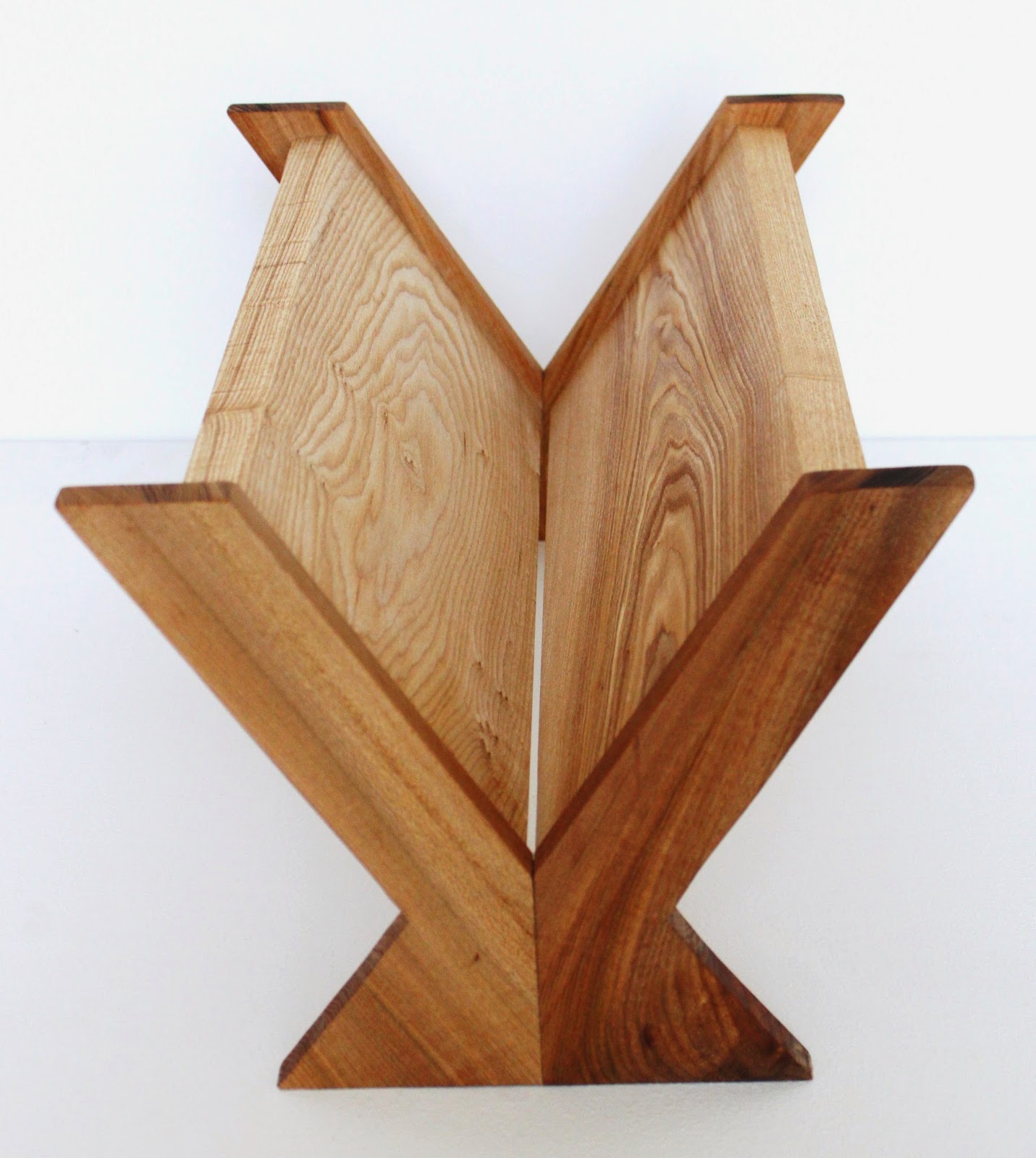
"The magazine rack was designed and finished with in an hour and a half and was meant to reflect aspects of the table. such as geometry and construction techniques. The idea came from a fellow student suggesting that I should dress my desk with a sketchbook. Andrew Johnston

Wednesday, 25 June 2014

Zee Chilufya II


Zee Chilufya's design for a glass topped table was based on the form of a simplified spider. With walnut and oak inlaid detail on the central apex joint.

Tuesday, 24 June 2014

Zee Chilufya


Zee Chilufya's reproduction project was the Steltman chair designed in 1963 by Gerrit Rietveld the Dutch furniture designer and architect for G. van de Groenekan.

Monday, 23 June 2014

Andrew Johnston II


Andrew Johnston took all of the elements of different writing desks that he liked and combined them in this elegant, simple and functional desk.

Wednesday, 18 June 2014

Fiona Smyth I


Fiona Smyth has just completed her HND at Fife college and has had a passion for upholstery since she first explored the techniques at NC level, This is her 'Moon Chaise' a reproduction piece after the original Contour Chaise designed by Vladimir Kagan  in the 1950's.

 "I am a huge fan of his work, I love the smooth curves and soft comfort." Fiona Smyth

The design was slightly adapted with an adjusted back and using only one 'unupholstered' arm. as Fiona wanted the chaise to have the different surfaces of the wood and upholstery to be more visually balanced and the chaise to be very smooth and tactile.

Sunday, 15 June 2014

Dan Turner's 360 Hour Desk


Inspired by the work of Robert “Mouseman” Thompson, the Bureau is made from solid native Oak bought from Scottish Woods near Oakly. The paneling is veneered Oak, a compromise of time, cost and stability. Largely made using just hand tools, the desk features solid wood tops and writing surfaces, hand cut dovetailed draws with custom made pulls and through tenon cupboard doors held in place with hidden magnets. Two Easter Island statues (called Moia) create the pulls for the lopers which support the highly figured lid/writing surface.
This was part of a reproduction module for the HND course I have just finished, the brief was to choose a piece of furniture that we liked, research its design, the maker and its construction method. Where drawings weren't available we had to make an educated guess on how it was put together.
As there were no drawings for this desk I looked at others from the same time period, including the Arts and Crafts Movement and Gustav Stickley and researched traditional construction methods for frame and panel type furniture.
I made a few changes from the original, I wanted the writing surface to be higher from the ground as I’m 6’4” and most bureaus I know are quite small! I also changed the configuration of the pigeon holes and added two cupboard doors in place of the 2nd and 3rd draws.

Robert Thompson got the nickname ‘Mouseman’ from the small mouse he carved onto each piece of his furniture. Continuing his legacy, the craftsmen of Robert Thompson LTD each have their own variation on the mouse which they carve onto each piece they make. I wanted to do something of similar meaning to my desk and decided on the Easter Island Statue.

The statue was the reason for me starting to explore wood working. After watching ‘A Night at the Museum’ with a friend and finding the character ‘Dumb Dumb’ hilarious I decided I had carved enough spoons, it was time for something more challenging. The Desk symbolises everything I have learnt whilst on the HND course as well as a new chapter in my woodworking career.

Saturday, 14 June 2014

Damian Pinardi I


Conceptualized by the Argentinian furniture designer Damian Pinardi, "The Three Bridge Table" has its inspiration from the Forth Bridge and a tree itself; merging human and nature technology; as the bridge connects two lands so the trees connect the earth with the sky above.... Three Bridge Table stands at 60cm from the ground, which makes it perfect to create a fully accessorized set with our stools' catalogue. To be used either indoor as a center table or outdoor for a delicious intimate early dinner in the summer! This eye-catching coffee table is made from Eco friendly elm, spalt beech and poplar, built to last for years if well taken care of.

Wednesday, 11 June 2014

Radenko Velinov


"This project combines my passion for shooting and the enjoyment of making solid wood furniture.The brief for the table was developed in discussion with the Perth Small Bore Rifle Club and the inspiration behind it is the Rifle scope reticle and the shooting targets.
It is made of American maple and birds eye maple.  The reticle cross and the mil dots are Ebony and the steam bent rail is of Scottish Ash. The edges and rail are scorched to blacken them. The legs are shaped as Rifle scopes. The wood is finished with several coats of Superior Danish oil and the decoration includes a  selection of random calibers, (from .22 to .308), spent casings, the rarest of which are more than 40 years old Holland & Holland. The top is 6mm toughened  glass." Radenko Velinov

Wednesday, 4 June 2014

Jade Milne II


The Step Stool by Jade Milne.

"I designed this stool to meet a brief given to the class: Design a three legged stool, but no two of the legs can be the same. Another caveat was that each leg had to be "shaped" in some way. As someone who loves straight lines and angles and symmetry, this was a real challenge for me.

I knew almost instantly that I didn't want to go down the route of making a stool with three completely unrelated legs, I definitely wanted to make something with a coherent aesthetic, not merely fulfill the brief and tick the boxes.

Research was a vital stage for me here. I looked at a huge range of stools and beyond, tables and chairs too, including furniture made specifically for children, which is an area that interests me but I rarely see anything I like in it. I didn't limit my research to three-legged objects, as I didn't want my design to look immediately asymmetrical or 'wonky.' I became very interested in the idea of having moving parts, and especially so in objects which served multiple purposes. As someone who doesn't own a stool, and would rather sit in a chair, I thought a lot about who uses them, and what purpose they really serve. I spent a long time researching and sketching, dissecting designs to figure out exactly what it was that I liked and disliked about certain pieces. I liked modern curves. I disliked the theatrical, cartoonist designs of children's furniture. I liked things that were simple. 

Eventually I settled on the idea of a stool for children to use, that doubles as a sort of step ladder. As much as we, as adults, like to put things away on shelves, children like to take things down again! Toys, and books are tidied away, often out of reach. I think there's something nice for a child to be able to get something down themselves. To reach the highest shelf means to be a grown up!

The manufacture of the Step Stool was a fun process. In the end I loved the curves which I so often shy away from. I love the way you can follow the line of the joint, stepping up and down and up again across the curve. I love the oak especially, it doesn't throw up too many surprises!